A Slow Morning at Shakespeare and Company Café in Paris
I’m writing this from Shakespeare and Company Café in Paris, rain tapping gently against the window while a woman nearby reads a worn paperback, completely absorbed. In the mirror in front of me—not the window, but the mirror—I can see the street reflected back, a frame within a frame. I’ve been sitting here for two hours, and for the first hour I didn’t take a single photograph.
The Difference Between Looking and Seeing in Travel Photography
For years, travelling the world as a flight attendant, I thought I was truly seeing it because I was there with a camera in hand. But I wasn’t seeing; I was looking. Looking is passive. You scan a street, register buildings, people and light, and move on. Seeing is active. It requires intention, attention and the willingness to slow down long enough to notice what actually matters.
I used to arrive in a city and immediately start shooting—hundreds of images a day, thousands by the time I returned home. Most weren’t strong, not because I lacked skill, but because I hadn’t truly seen anything. I was collecting photographs instead of paying attention.
A Barcelona Balcony and the Power of Slow Observation
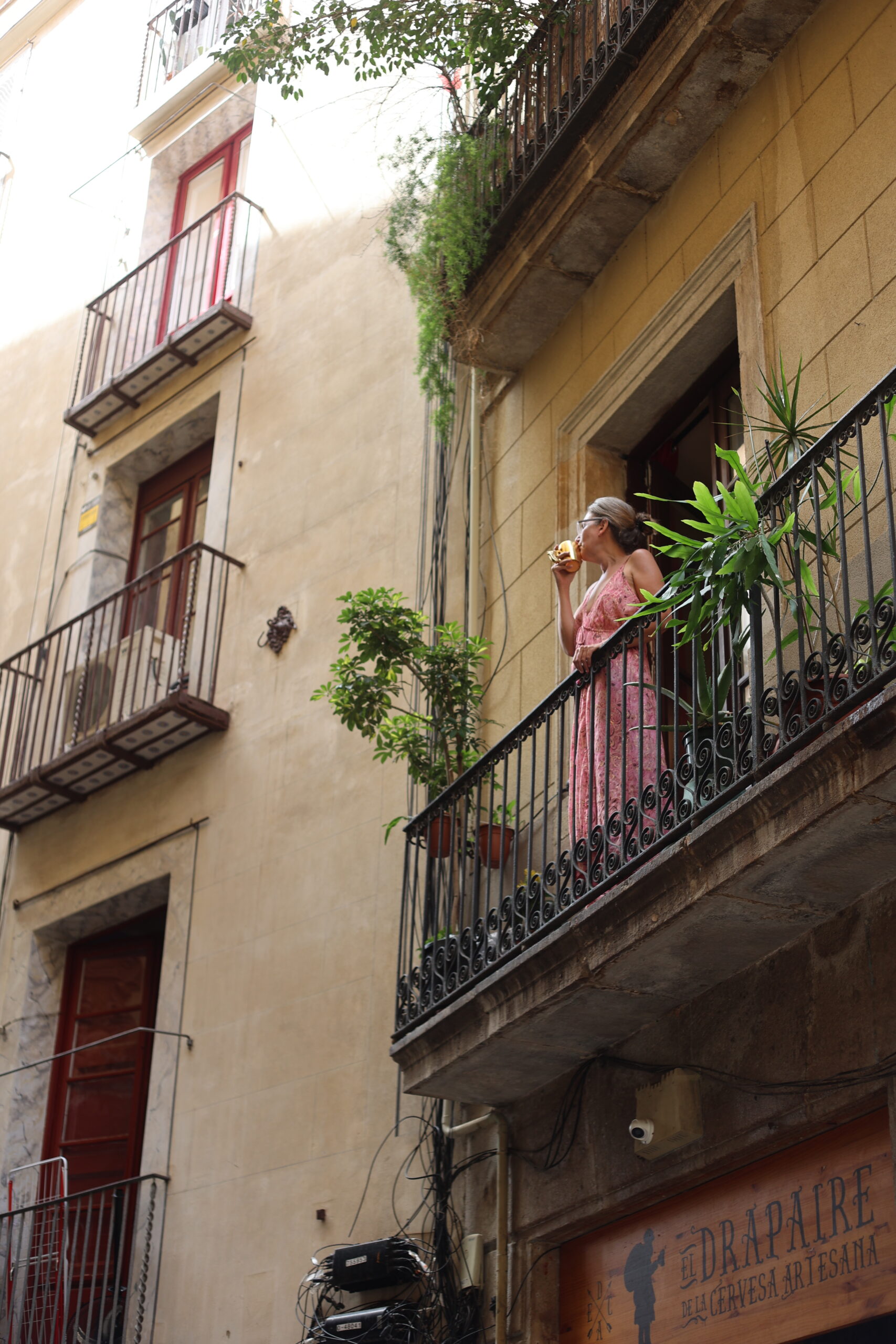
Three years ago in Barcelona, something shifted. I was walking beneath balconies strung with washing when one caught my attention. It wasn’t iconic, just ordinary, but the light and geometry made me pause. I waited across the street for fifteen minutes. Then a woman stepped out with her coffee, looked over the railing and gently kissed the side of her cup. It was a small, intimate gesture, and I captured it.
That photograph became one of my favourites, not for its technical perfection but for its presence. At the time, I thought the lesson was patience. Only later did I realise it was about slowness—about being fully in a moment rather than rushing toward the next one. It was a lesson in mindful photography and creative attention.
What Slow Travel Photography Really Means
Slow, for me, doesn’t mean walking at half speed. It means permission: permission to arrive without urgency, to sit without producing, to notice without performing. When I came into this café in Paris, I felt restless and ready to chase images. Instead, I stayed still.
The rain pushed people inside. Umbrellas dripped at the door. I ended up seated beside a mirror rather than the front window I wanted. In that mirror I found my frame. Through it, I borrowed the street from a stranger’s perspective and watched a woman pass beneath her umbrella, blurred by rain and motion. I waited, then photographed.
That quiet, reflective image became the opening of my Paris series, and it only existed because I chose to sit first. This is the essence of slow travel photography: observation before action.
Photography as a Practice of Attention and Presence
Photography is less about collecting images and more about attention. Technical skill matters, but attention is the real craft—the ability to recognise what is worth photographing in the first place. It allows you to see potential in an ordinary balcony or an unexpected reflection.
Attention deepens when you slow down. In Paris, I’m returning to the same streets, sitting in the same cafés and limiting my subjects—doorways, hands, signage, reflections and light on stone. Constraints force me to choose carefully. Each day I sit before I shoot, and each evening I reflect on what I noticed and what I nearly missed.
The practice is simple, but it changes everything.
Why Learning to See Slowly Matters Beyond Photography
You don’t have to be a photographer for this to matter. Seeing applies to writing, to design, to parenting, to leadership. In a culture obsessed with speed and output, attention is radical. When you learn to see, you live differently and create differently.
Slow living and creative presence are not luxuries; they are disciplines. They shape the depth of your work and the quality of your relationships.
How to Practice Seeing a City Slowly
If you want to experiment with this approach to slow travel and photography, try this:
- Choose a place—a café, park or street corner.
- Sit for 30 minutes without your phone.
- Observe the light, movement and small human details.
- Then create.
Notice what changes. Notice what you would have missed.
A Final Reflection on Slow Travel and Creative Attention
The world doesn’t need more people who know how to use a camera. It needs more people who know how to see. Seeing is a skill. It’s a practice. And it begins by slowing down.