Osaka is Japan at its warmest and most unbuttoned — a big, generous, food-obsessed city where eating alone at a counter is the most natural thing in the world. After the refinement of Kyoto and the scale of Tokyo, Osaka feels like an exhale: louder, friendlier, and endlessly delicious. This guide covers when to visit, where to stay, what to eat and drink, and the experiences worth making time for — written from personal visits.
Osakans are famous across Japan for their humour, directness, and love of a good meal — and that easy warmth makes the city wonderfully welcoming to solo travellers.
It is a city built around its appetites. The phrase kuidaore — "eat until you drop" — was practically invented here, and the streets of Dotonbori glow with the proof of it.
It is also remarkably easy to navigate alone: safe at all hours, compact at its core, and forgiving of travellers who simply want to wander, eat, and watch the city go by.
Destination Guide
When to Visit
Osaka is rewarding year-round, but spring and autumn bring the kindest weather and the prettiest light.
Spring (Mar–May)
Cherry blossom along the castle moat and Kema Sakuranomiya Park. Mild, festive, and beautiful — book accommodation early.
Summer (Jun–Aug)
Hot and humid, but alive with energy — the Tenjin Matsuri in July, with its river processions and fireworks, is one of Japan's great festivals.
Autumn (Sep–Nov)
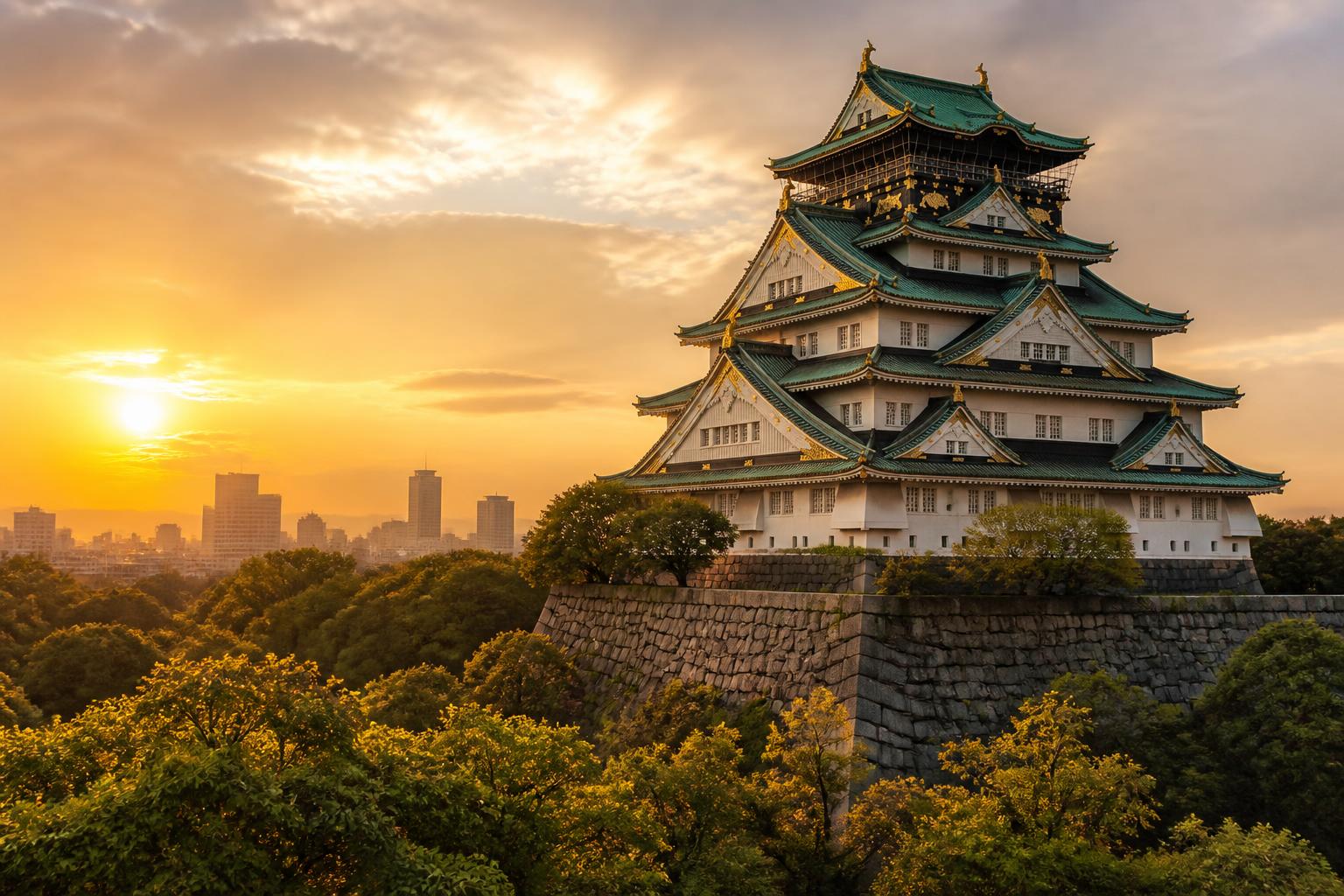
Crisp air and golden foliage around the castle and city parks. Comfortable days and clear light — an ideal time to walk and eat your way around.
Winter (Dec–Feb)
Cold but rarely snowy, with bright illuminations and steaming bowls of street food. Fewer crowds and lower prices.
- Cherry blossom (late March–early April)
- Tenjin Matsuri (late July)
- Autumn colour (mid–late November)
Destination Guide
Getting There & Around
Most travellers fly into Kansai International Airport (KIX) or arrive by Shinkansen at Shin-Osaka — both connect smoothly to the city centre.
Once you're here, getting around is simple:
- Trains from KIX reach central Osaka in around 50 minutes (Nankai or Haruka)
- The Shinkansen links Shin-Osaka to Kyoto in 15 minutes and Tokyo in under three hours
- An IC card (ICOCA, Suica, PASMO) taps you on and off the subway and trains
- The Midosuji subway line runs through the heart of the city, linking the main districts
Destination Guide
Where to Stay
Your base sets the tone — Osaka's two main hubs offer quite different rhythms.
Namba & Shinsaibashi (Minami)
For street food, nightlife, and Dotonbori on your doorstep — the liveliest, most central base.
Umeda (Kita)
For department stores, sky gardens, and seamless transport links — polished and convenient.
Shin-Osaka
For Shinkansen access and easy day trips — practical if you're hopping between cities.
Tennoji
For a calmer, more local feel near parks, temples, and the Abeno Harukas tower.
Destination Guide
Top Experiences
Osaka's best moments are loud, bright, and full of flavour.
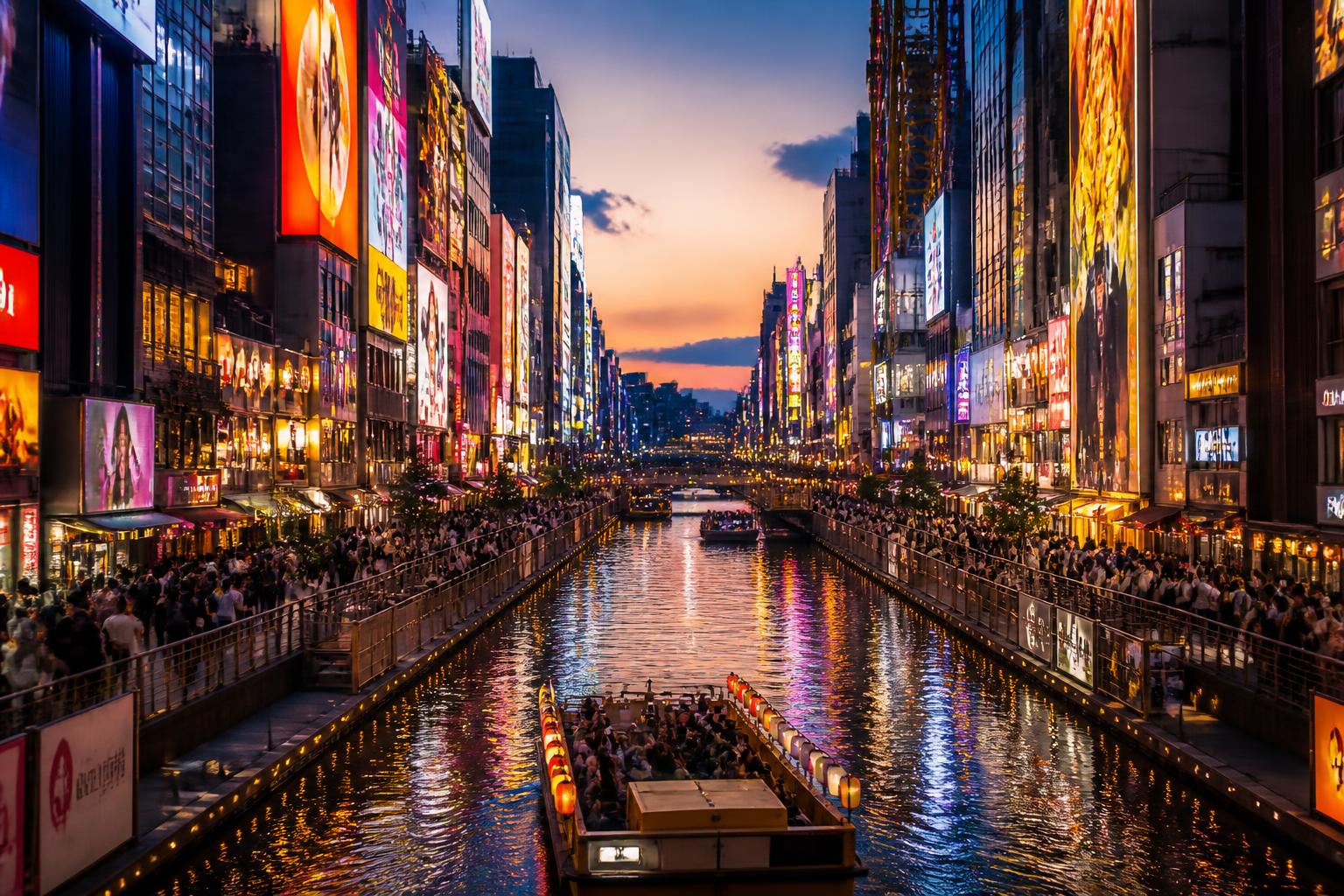
- The neon riot of Dotonbori at night, reflected in the canal
- Osaka Castle and its gardens, especially in blossom or autumn colour
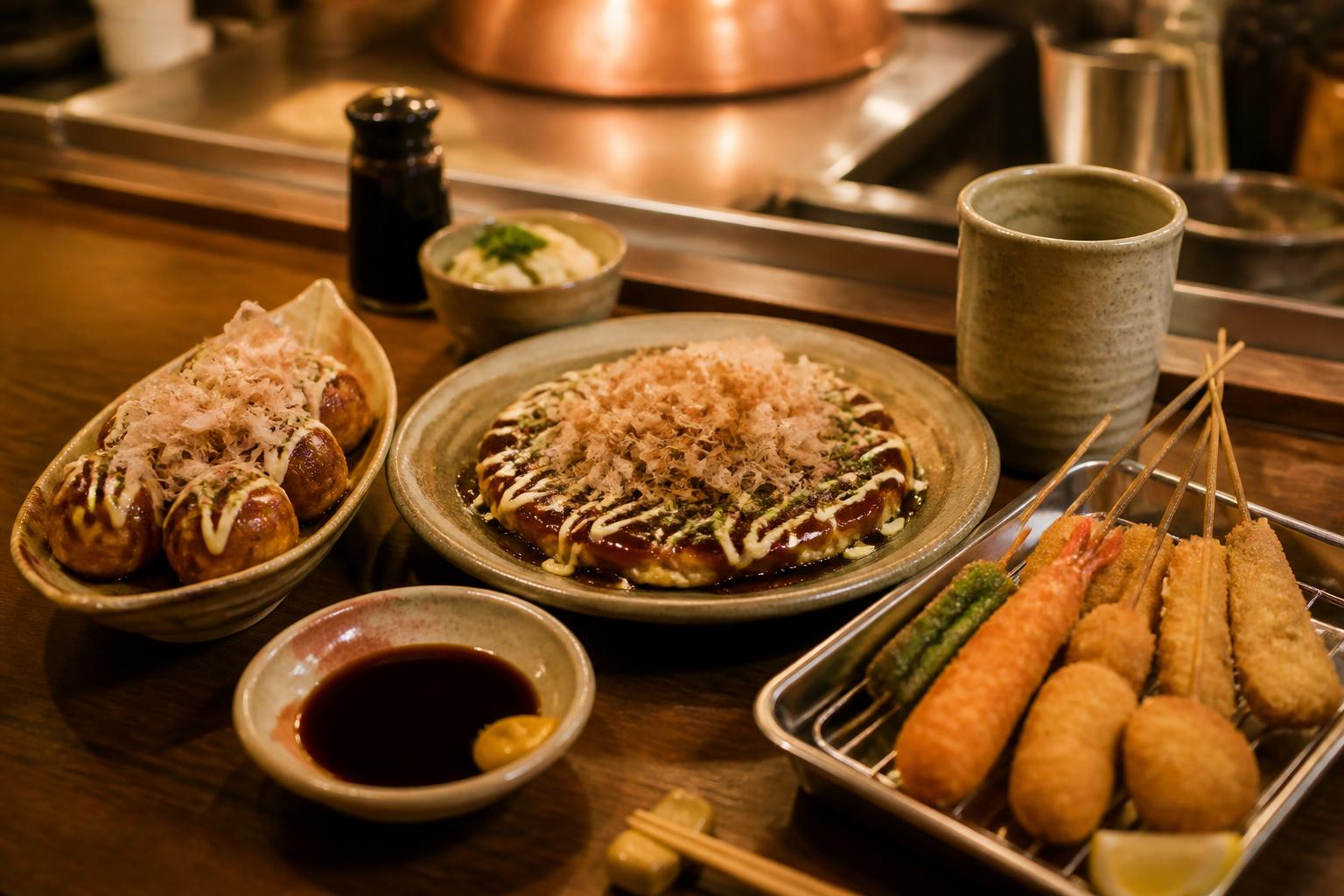
- A street-food crawl through Namba — takoyaki, okonomiyaki, kushikatsu
- Sunset from the Umeda Sky Building's floating garden observatory
- Shinsekai's retro lanes and the towering Tsutenkaku tower
- Early-morning calm at Sumiyoshi Taisha, one of Japan's oldest shrines
Destination Guide
Food & Drink
Osaka is Japan's kitchen — bold, unpretentious, and made for eating alone at a counter or standing at a stall.
Mornings might be a fluffy soufflé pancake or a quiet coffee in a retro kissaten café.
Lunch is where solo travellers thrive — a counter set, a bowl of kitsune udon, or a plate of takoyaki eaten on your feet.
Evenings belong to Dotonbori and the backstreets of Namba: tiny izakayas, kushikatsu joints, and griddle counters glowing late.
A few things to seek out —
- Takoyaki — molten octopus dumplings, Osaka's signature snack
- Okonomiyaki — the savoury griddled pancake you cook (or watch cooked) at your table
- Kushikatsu — crisp deep-fried skewers in Shinsekai (one dip only!)
- Kitsune udon — the comforting bowl said to have been born here
- Kuromon Ichiba Market for sashimi, grilled scallops, and snacks
Destination Guide
Neighbourhoods
Each district of Osaka has its own distinct character.
Dotonbori & Namba
The glowing heart of Minami — canalside neon, street food, and round-the-clock energy.
Shinsaibashi
The shopping spine — a long covered arcade running from boutiques to bargains.
Umeda (Kita)
The polished north — skyscrapers, department stores, and the floating sky garden.
Shinsekai
Retro and gritty in the best way — kushikatsu lanes beneath the Tsutenkaku tower.
Destination Guide
Shopping
Osaka shopping ranges from glittering department stores to chaotic kitchenware streets — easy to fold into a day of wandering.
- Kitchenware and chef's knives along Doguyasuji arcade
- Fashion and beauty through the Shinsaibashi-suji arcade
- Quirky finds and Americana in the Amerikamura district
- Food souvenirs — snacks, pickles, and sweets from Kuromon Market
Destination Guide
Sample Itinerary
One Day
Osaka Castle in the morning, Kuromon Market for lunch, then Dotonbori and Namba for a street-food evening.
Three Days
Add Umeda's sky garden, Shinsekai and kushikatsu, Sumiyoshi Taisha, and a half-day shopping the arcades.
Five Days
Use Osaka as a base — day trips to Kyoto, Nara, and Kobe, with plenty of time to eat your way home.
Destination Guide
Day Trips
Osaka is the perfect base for the Kansai region:
- Kyoto — temples, gardens, and geisha districts, 15 minutes by Shinkansen
- Nara — ancient temples, a giant bronze Buddha, and free-roaming deer
- Kobe — harbour views, sake breweries, and the famous beef
- Himeji — Japan's most beautiful original castle, gleaming white
Destination Guide
Travel Tips
A few small things that make Osaka easier:
- With kushikatsu, never double-dip the shared sauce — it's the one firm rule
- Carry some cash — many stalls and small counters are cash-only
- An IC card covers subway and trains; tipping isn't expected anywhere
- Stand left on escalators in Osaka (the opposite of Tokyo)
Destination Guide
Getting Around
The subway makes the whole city reachable, with the Midosuji line linking Umeda, Shinsaibashi, Namba, and Tennoji in one straight run. But Osaka rewards walking too — the canals, arcades, and backstreets are best discovered on foot.
Destination Guide
Signature Moments
These are the moments Osaka gives you.
The first bite of takoyaki, too hot, straight from the stall.
Neon signs shimmering on the Dotonbori canal at night.
A counter cook flipping okonomiyaki as you watch.
A stranger's easy laughter over a shared izakaya table.
It simply pulls up a stool, pours you a drink, and tells you to eat — one counter, one canal, one warm welcome at a time.